
JuLenny is live: let a partner compute on your data without ever exposing it
David Uzan · 18 August 2026
Enterprise data partnerships die at NDA review. Not because the partnership wasn't valuable, but because every "share to compute" option on the table required somebody to see the cleartext: the counterparty, a clean room operator, a third-party processor, the platform itself. Somewhere in the chain, raw data had to sit readable on someone else's machine, and legal said no.
Today we're launching the JuLenny platform to make that chain unnecessary.
What it is
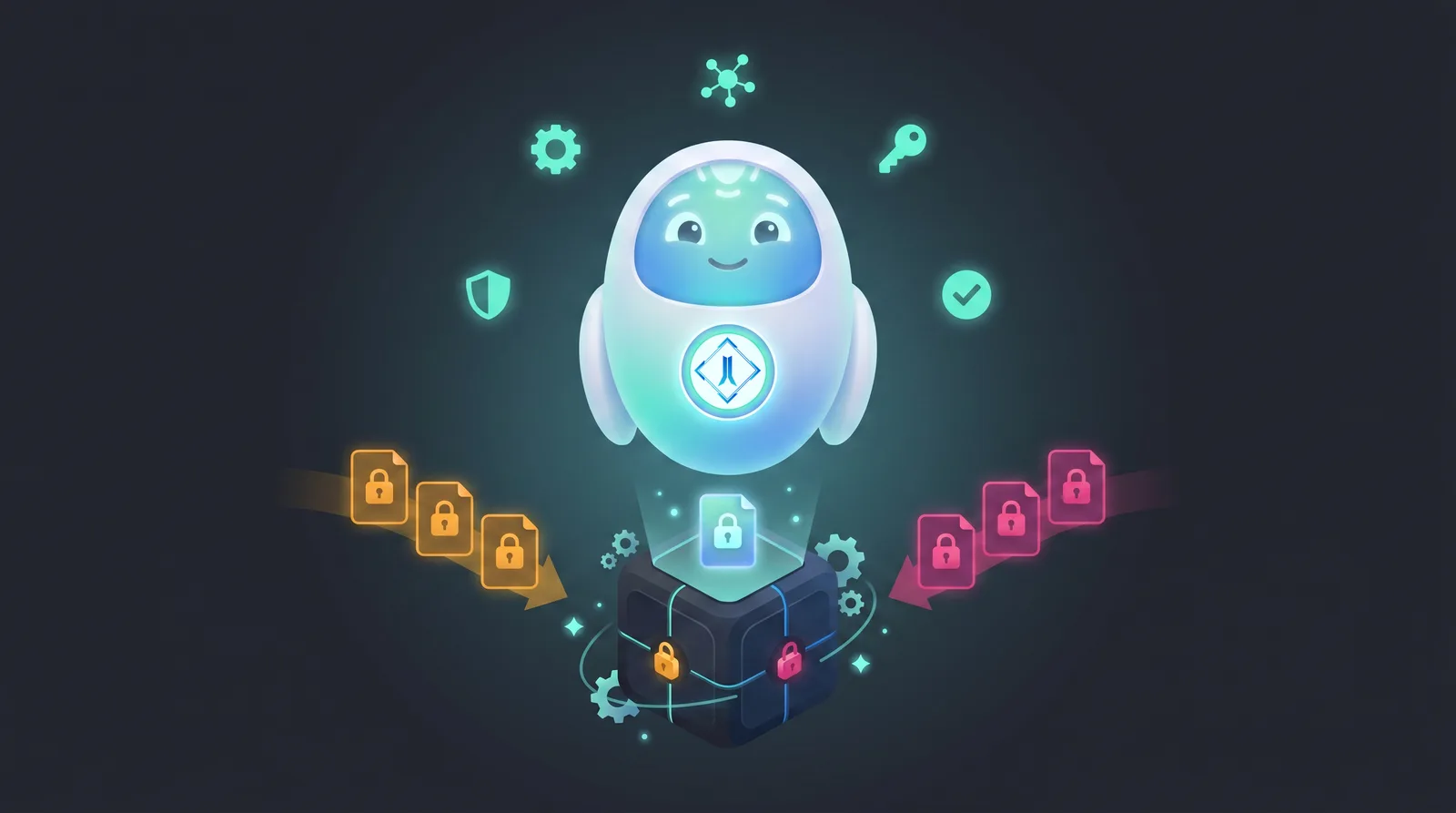
JuLenny is a multi-party data collaboration platform built on threshold fully homomorphic encryption. Two or more organizations run an agreed computation on their combined data, and nobody sees anybody's inputs. Not the counterparty. Not JuLenny.
The trust model is the product, so it's worth spelling out:
Each party encrypts its data locally, on its own machine, using the JuLenny client app. Raw data never leaves its owner's premises.
The encrypted contributions are combined under a joint key that no single party holds. Not even us. There is no master key sitting in our cloud waiting to be stolen.
Every computation runs from a curated, signed function library. Both parties know exactly what will be computed before they contribute anything, and no logic can change quietly between runs.
Results are decrypted only when every contributor signs off. Until then, everything in the system, including the output, is ciphertext.
The consequence: even a full compromise of JuLenny's cloud exposes nothing readable. This is zero trust by protocol, not by policy. We don't ask partners to trust our procedures; the cryptography removes the need. The math is the contract.
You don't have to take our word for it
That last paragraph is a claim, and claims about privacy are cheap. So we built the platform so you can check it yourself, before you talk to anyone here.
Create an internal collaboration, your own company granting to itself. It skips the two-party key handshake, so there is no counterparty to wait for and nothing to arrange. Encrypt your own data with the client app, upload the ciphertext, run a computation, decrypt the result. All the cryptography happens offline, on your machine.
That self-test is how you verify, first-hand, that we only ever held ciphertext. It takes about thirty minutes, it's free, and it needs no partner, no security review, and no call with us.
The client app is source-available under BSL 1.1 and built on OpenFHE, the open-source FHE library. Install it and start, or read the code and compile your own build instead of running ours. If you'd rather trust nothing at all from us, build your own client directly on OpenFHE. The platform doesn't care whose binary encrypts your data, only that the cryptography is right. You never have to trust software you can't inspect, not even ours.
Nothing to deploy
FHE has a reputation for being a deployment project, and it has earned it. Consortium platforms need nodes stood up across every participant's infrastructure, which means a security review, a platform team, and a quarter of work before anyone computes anything.
JuLenny is a client app for Windows and Linux, with ready-to-run example scripts for every function and a local MCP server. Nothing to stand up across your estate. Nothing for your platform team to operate. Nothing for your security team to review beyond a client whose source they can read.
What you can compute, today
The platform launches with a function library covering five collaboration patterns, each with its own deep-dive article on this blog:
Joint Record Overlap answers "how many records do we share?" Two organizations get the overlap count between their customer lists, threat databases, or catalogs, without either list being revealed. An itemized variant shows each party which of its own records matched. In a world without cookies and device IDs, this is also how an advertiser and a retailer measure ad conversion without sharing user lists.
Rule-Based Cross-Match answers "does my data conflict with yours under public rules?" Drug interactions against a patient's medications, allergens against a recipe, regulatory clauses against planned activities. Only the matches surface; everything else stays hidden.
Federated Average lets two organizations combine locally trained machine learning models into one better model, without either side exposing its training data or its weights.
Decision Tree Inference runs one party's trained classification model on another party's encrypted data: credit scoring, fraud detection, medical triage. The data owner never reveals its records, the model owner never reveals its model, and the only thing that comes out is the classification.
The Encrypted Negotiation Matrix tells two negotiating parties whether their acceptable terms overlap, without either side revealing its position, and without failed rounds leaking anything at all.
Each function ships with a plain-language explainer and example scripts that walk through the complete flow, app and API included, written to be read as much as run. And every step of a collaboration works through both the web dashboard and the API, so you can start in one and continue in the other.
Beyond the library
The library is the beginning, not the scope. The function set grows with our partners' use cases.
And if your use case doesn't fit an existing function, we develop custom functions for customers, for their exclusive use. Your proprietary logic becomes a signed function in the registry, available only to your collaborations, with the same guarantee as everything else on the platform: it runs on encrypted data, and nobody sees your inputs.
The platform also ships with an MCP server, so AI agents can work with JuLenny natively: setting up collaborations, triggering computations, checking results, the same way they already work with code repositories and databases. The agent drives the workflow through an API key, constrained by that key's permissions, and never has access to plaintext. If your organization has been holding back on putting AI near sensitive data, this is what that looks like when the model structurally cannot read it. And if agents aren't part of your pipeline, the example scripts give you the same automation without one.
Getting started
The platform is open. Create an account and run the self-test described above, free, on your own, with you playing both sides. Want to try more functions? Buy credits and keep going. And when you're ready for a real multi-party collaboration, our plans take it from there.
Every step works through the web dashboard or the API, and the client app handles all key operations on your own machine.
If there's a question your organization and a partner have both wanted answered for years, and the only thing standing in the way is that neither of you can show the other your data, that's exactly what we built this for.
Start free at julenny.net, or get in touch if you'd rather talk it through first.